
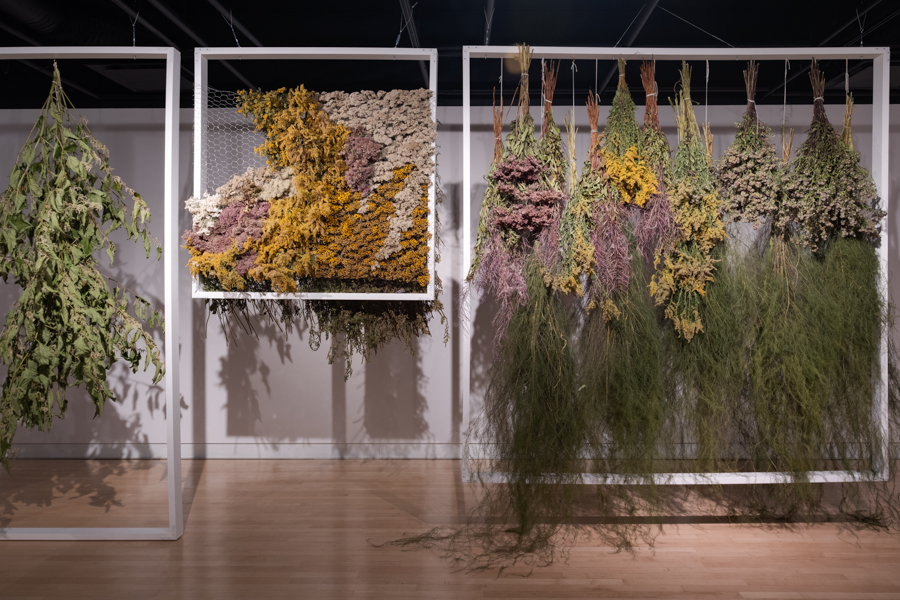
Geneviève Baril grounds her work in a regular practice of walking and gathering in nature, while respecting the land’s capacity for regeneration. She presents a first iteration of this project, titled Anthology of Walking (2022), as part of the Trois-Rivières National Biennial of Contemporary Sculpture in 2022. This installation, rooted in the region where she works and lives, leads her to explore the banks of the St. Lawrence River, the edges of agricultural areas, and the forests of the Mauricie region.
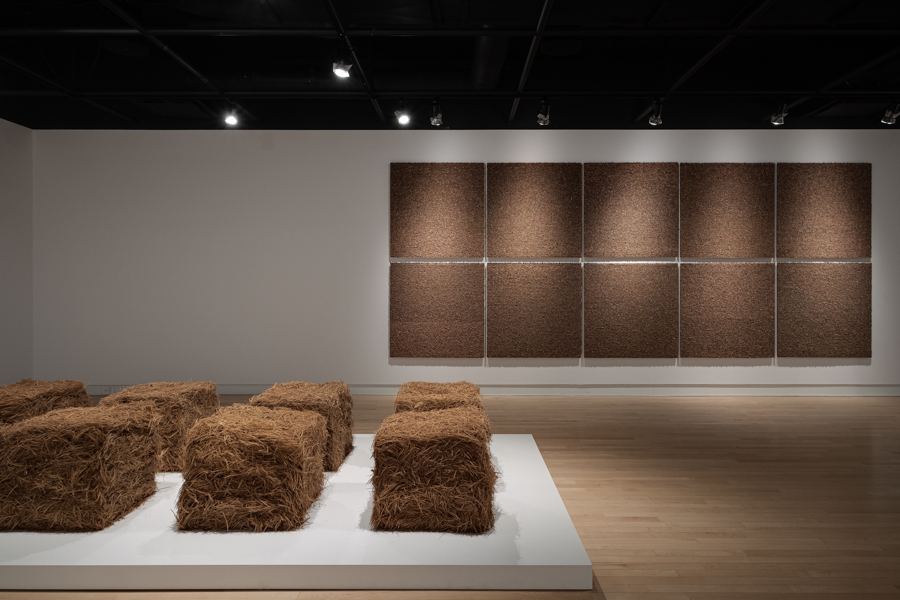
The work unfolds in two parts and is presented in separate spaces. In Broder le temps / La simplicité des choses est difficile à dire, the artist rearranges pine needles and pine cones into simple forms. The accumulation of these tiny elements, meticulously juxtaposed within these cubes or panels, bears witness to a long and painstaking process of creation and to frequent visits to the forest. In the second part, I Will Be Your Mirror / My Garden Will Be a Place of Resistance and Rebellion, specimens of wild plants, left largely in their natural state, are hung on suspended frames, following the rhythm of the artist’s recurring walks. Geneviève Baril thus invites us to experience the territory and its transformation over the course of the season alongside her. The potent scent of the wildflowers set out to dry physically transports us to the heart of the natural environments traversed, while the odor of their slow decay places them within a cycle of life, death, and rebirth at the heart of natural processes.
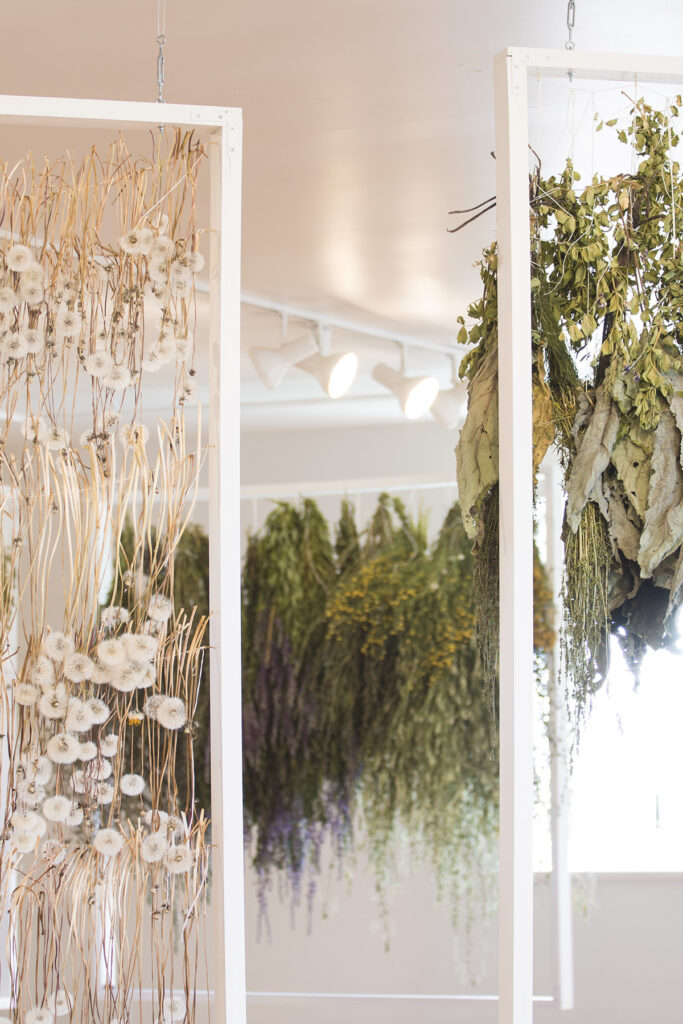
In 2024, the artist was invited to repeat the same actions as part of an artist residency at the Centre d’art de Kamouraska, in order to explore another territory using the same protocols. She also plans to explore the various habitats along the banks of the St. Lawrence River, particularly those of the islands found there. She does not visit these places as a tourist, but immerses herself deeply in them through a regular practice of walking and gathering. By its “holistic” nature, her approach to exploring and observing nature resembles a systematic scientific method. She focuses, however, on an embodied experience of nature rather than its classification, and invites us to forge a richer, symbiotic connection with our environment.
Discover Geneviève Baril’s artistic approach. (In French)
Visit the “Art and Environment Capsules” webpage of the Grantham Foundation for Art and the Environment: https://www.fondationgrantham.org/capsules-art-et-environnement; see Capsule #15 for this text.